
Infrastructure
Building Killough AD Plant
Ireland needs renewable energy and sustainable materials to build homes at scale while meeting climate targets.
Renewable energy for Ireland's sustainable future
Killough AD Plant converts local organic waste into biomethane and clean fertiliser, supporting Ireland’s climate targets and housing growth. Roadstone and Utopia are building the infrastructure that makes sustainable construction possible at scale.
Challenge
Ireland's dual commitment to housing and climate
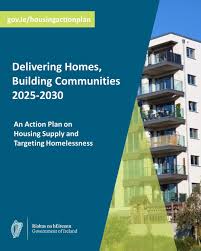
Ireland’s 2025–2030 housing programme commits to delivering up to 300,000 new homes while meeting a legally binding target to reduce national emissions by 51 percent by 2030. As housing delivery accelerates, policy led by the Department of Housing, Local Government and Heritage and the Department of Environment, Climate and Communications is embedding sustainability across construction, energy use, and materials, including the shift toward heat pumps, renewable electricity, and lower-carbon building inputs. Supported by the Housing Agency’s focus on creating sustainable communities rather than isolated developments, this transition places growing emphasis on the carbon footprint of construction materials themselves. Roadstone’s decarbonisation strategy, including the integration of renewable energy and lower-carbon production processes, aligns with these national objectives by supporting the delivery of essential construction materials while reducing lifecycle emissions across Ireland’s housing and infrastructure pipeline
80% renewable electricity by 2030
51% emissions reduction target by 2030
Tens of thousands of new homes annually
Roadstone's path to decarbonisation

Roadstone leads Ireland’s building materials sector with clear targets for decarbonisation, circularity, and water stewardship. Since 2021, the company has saved 107.5 kilotonnes of CO2 equivalent, trialled 300,000 litres of HVO fuel, installed 4.1 megawatts of solar capacity, and integrated 70% reclaimed asphalt into mixes. Forty third-party environmental product declarations and one constructed wetland demonstrate measurable commitment to sustainable practice.
Build
How Killough AD Plant is designed and built
The Killough Bio-Renewables facility is a local circular project designed to turn agricultural materials, such as grass silage, cattle slurry, and chicken litter, into clean renewable biomethane gas and sustainable fertiliser products. By using 105,000 tonnes of feedstock sourced mainly from farms within 20 kilometres, the plant creates a reliable loop between local energy and local land. To protect the local landscape, the entire facility is located within the existing footprint of the Killough Quarry, which means no new greenfield land is being used for the development.
Safety and environmental protection are built into every stage of the design. All material reception, storage, and processing happen inside fully enclosed, sealed buildings and roofed tanks to ensure the process remains entirely contained. This “no-waste” approach captures everything, even the carbon dioxide is purified for industrial reuse, while any water used on site is treated and recycled within the quarry operations. This ensures there is no discharge to local rivers or streams.
The project represents a significant long term investment in the local economy, creating 15 to 20 permanent jobs for the community. Beyond employment, the facility generates clean energy to power local industry and provides farmers with high quality pelleted organic fertilisers that reduce the need for expensive chemical alternatives. With over 10,000 square metres of solar panels generating green electricity on the roofs, the plant is a modern sustainable addition to the region that supports both climate goals and rural resilience.
- Biomethane production and gas upgrading systems
- Digestate processed into pelleted organic fertiliser
- 15-20 Permanent Jobs
Process
Killough Bio-Renewables: Our Stage-by-Stage Process
This detailed guide explains the day to day operations at our facility. Our design ensures that every step of the process is managed within a controlled industrial environment to protect the local area.
Stage 1 - Arrival and Quality Checks
Every delivery arrives via the existing quarry entrance and proceeds directly to the weighbridge area. Here, all materials are weighed and logged as part of a formal feedstock acceptance agreement. This rigorous checking process ensures that only suitable organic materials enter the site, preventing any non-target waste from being processed.
Stage 2: Fully Enclosed Reception
Fully Enclosed Reception To eliminate the risk of nuisance to our neighbours, all unloading happens behind closed doors. Solid materials are tipped inside the Dry Matter Reception Building, while liquid materials are transferred via sealed pumping systems into air-tight storage silos. These buildings operate under negative air pressure to ensure that no air escapes when the doors are opened.
Stage 3: The Natural Bio-conversion Process
Inside the Bio-conversion Building, the organic material is broken down in an oxygen-free environment using modular reactors. This is a entirely natural biological process that mimics what happens in a cow’s stomach, but it is performed in a 100 per cent contained industrial system. This enclosure ensures that the natural gases produced are captured rather than released into the atmosphere.
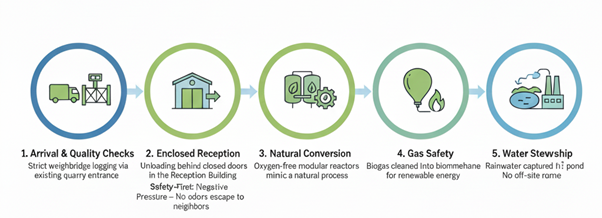
Stage 4: Gas Upgrading and Safety Systems
The biogas captured during digestion is cleaned and upgraded into high-quality renewable biomethane. Our site includes dedicated safety infrastructure, such as a gas storage balloon with a maximum height of 16 metres and a flare area. These systems are designed to manage the gas safely and provide controlled operations at all times.
Stage 5: Responsible Water Management
The facility is designed for zero off-site discharge to protect local watercourses. Rainwater from the large building roofs is collected in a 1,900 square metre surface water pond. This water is then reused within the existing quarry operations, creating a sustainable water cycle that does not impact local rivers or streams.
Environmental management and continuous improvement
Roadstone leads Ireland’s building materials sector with clear targets for decarbonisation, circularity, and water stewardship. Since 2021, the company has saved 107.5 kilotonnes of CO2 equivalent, trialled 300,000 litres of HVO fuel, installed 4.1 megawatts of solar capacity, and integrated 70% reclaimed asphalt into mixes. Forty third-party environmental product declarations and one constructed wetland demonstrate measurable commitment to sustainable practice.
Identify and control
Every operational impact is monitored and managed within sealed systems.
Transparent objectives
Regular audits measure progress against waste and biodiversity protection targets.
Join Our Newsletter to Keep Up To Date With Us!

Turning local resources into secure low carbon energy and rural regeneration for Killough.